
Development of web services with complex business logic
We build web services with real logic: access roles, dashboards, integrations and real-time data processing. Not business-card sites — full-fledged systems that replace daily routine.
Review
Types of web services we build
Web service development is a broad field. Understanding that modern web services have become the foundation of a business's digital infrastructure, we specialize in projects with real complexity: access roles, business processes, external integrations. Here are the types of systems we work with most often.
Systems for interaction between companies and departments: roles, document management, synchronization. The API handles from 500 to 5,000 requests per minute without degradation
Personal spaces for users: orders, payments, statuses, history. Interface response — up to 200 ms even with thousands of concurrent sessions
Platforms with multiple participant types, transactions and catalogs. We implement escrow logic, ratings and disputes
Internal management tools: accounting, tasks, analytics, sales funnels. We connect to your existing IT infrastructure without a full replacement
Multi-tenant platforms on a subscription model — each client gets an isolated space with their own data and settings
Advantages
Why custom web service development — and not a CMS
A CMS is someone else's product with someone else's rules.
A custom system removes limitations for good.
One popular SaaS builder limits the number of API requests per plan — and a business either pays more or cuts functionality. A custom solution removes these limits for good.
Any complexity is implemented without hacks or workarounds
The database structure, API and services are designed for your task from scratch
No third-party updates that break the system. You control every change
A microservice architecture lets you grow without rewriting everything from scratch
For whom
Who is custom web development for
If your business has outgrown template solutions, custom-built online services for business are the logical next step
A unified accounting and communication system for teams in the field and in the office
Subscriptions, escrow, multi-currency — scenarios that don't fit a template
Moving internal processes into digital form without buying a boxed ERP
Your own architecture from the very start, not dependence on someone else's platform
If your business needs a web system with real logic, we’re the right choice
Discuss project →Effect
What web solution development gives companies
A web service in a business reduces manual operations and makes processes more transparent and manageable. A well-built web service gives the team back the time that used to go into manual routine
Less manual work
Automating routine operations frees up the team's time. Our clients' processing time for a typical request dropped by 30–60%
Fewer errors
When logic is moved into the system, the human factor is minimized. Critical in financial operations and document management
Process transparency
Managers see statuses in real time — without calls, Excel spreadsheets or email chains
Scaling without chaos
The system grows with the business rather than holding it back
Opportunities
What web service development includes
System Design and Architecture
⌄We start not with code but with understanding the task. We analyze business processes, map the user flow, and design the database structure and service architecture. We prepare an interactive Figma prototype that's approved before development begins. This saves you from costly changes at later stages.
Frontend development
⌄For enterprise systems we use Angular — it provides a clear structure and convenient growth with a large number of modules. For client portals and SaaS — React, delivering fast rendering and flexibility. We implement real-time interfaces via WebSocket: status and notification updates without reloading the page. LCP in our projects is up to 1.5 seconds.
Backend development
⌄Node.js — for microservices, REST APIs and business logic: it handles from 10,000 requests per second on a single service. FastAPI (Python) — for AI services and processing large data volumes. Web service development on these technologies allows implementing authentication, access roles, task queues and background processes. We document the API via Swagger/OpenAPI.
Database and storage
⌄The database type depends on the task. PostgreSQL and MySQL — for transactional systems with relational structures. MongoDB — for flexible data structures with frequent schema changes. Redis — for caching and speeding up system response several times over. File storage — S3-compatible solutions with a choice between cloud and on-premise.
Integrations
⌄We connect payment services (LiqPay, Stripe, Fondy), signing services (Diia.Signature, Vchasno), push notifications, email, SMS and messengers. Separately — the MCP protocol for connecting AI to corporate systems: when you need an AI agent to have access to your CRM or ERP data.
Infrastructure and Deployment
⌄Docker containerization, CI/CD via GitHub Actions, SSL, uptime monitoring and backups. Cloud or On-Premise — at the client's choice. We set up dev, staging and production environments so new versions ship without risk to the live system. That's what full web service development looks like — from code to stable performance.
Process
Web service development stages at Applic
The whole process is transparent — the client always knows what stage the project is at and what comes next. Development follows fixed milestones with no 'black boxes'
Briefing and estimation
We qualify the task: what the product is, who it's for, which systems it integrates with. A commercial proposal within 1–2 business days
Discovery and design
Requirements analysis, architecture, UI/UX in Figma. All logic, integrations and scenarios are fixed in the spec before development begins
Frontend
Component markup, building interfaces from Figma mockups, responsiveness. In parallel with the backend — no linear waiting
Backend
API, business logic, database, integrations, authorization. Environments and automated unit and integration testing
Testing and optimization
Functional and regression testing on real scenarios. Behavior under load — up to 1,000 concurrent users
Launch and support
Deployment to production, team training, handover of rights and documentation. Support SLA: uptime, updates, roadmap
Technologies
Tech stack
We choose technologies to fit the task — we don't try to solve everything with one tool
Casey
Completed web projects
Real Problems - Real Solutions
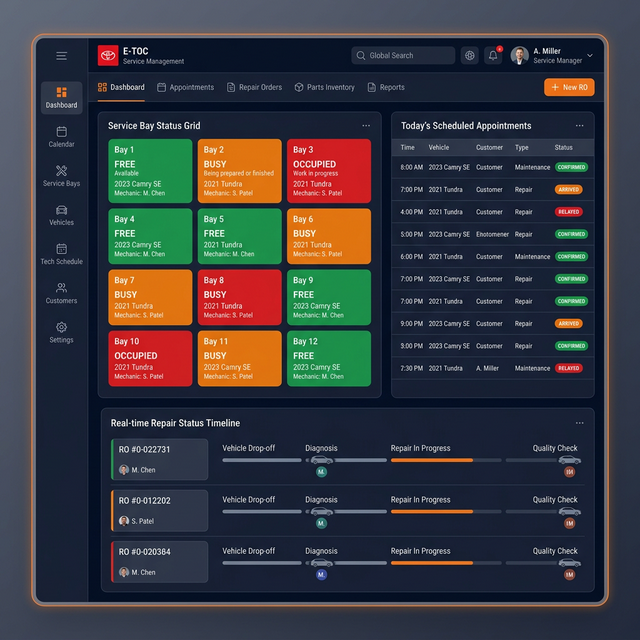
E-TOC
Toyota dealers
A platform for managing the service repair area for Toyota dealers. Online booking, workload management, and real-time repair status tracking.
Result: Reducing vehicle check-in time and increasing the transparency of the service area's operations.
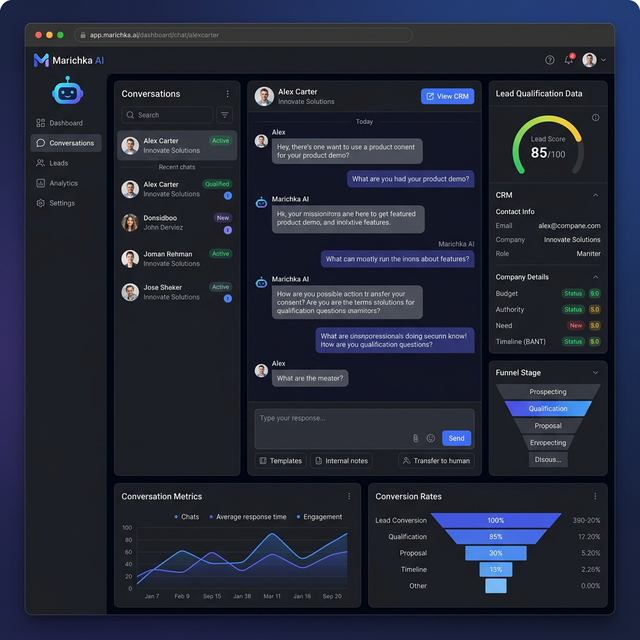
Marichka
Subscription model
AI sales manager as a web service — communicates with customers via website and messengers, qualifies leads, and transfers them to CRM.
Result: 24/7 processing of inquiries without manager participation.
FAQ
Frequently asked questions about web service development
What is a web service?
⌄A web service is a software solution that runs through a browser and implements complex business logic: data management, request processing, integration with other systems. Simply put — the same app that opens in a browser, but doing the work of a full-fledged corporate system. Unlike an ordinary website, it has roles, authorization and real processes inside. That's why online services of this kind have become the standard for companies automating business processes.
How is the cost of building a web service determined?
⌄If you're wondering how much it costs to build a web service — the answer depends on the number of modules, the complexity of the business logic and the scope of integrations. The decision to build a web service from scratch is usually justified when a business process doesn't fit any ready-made platform. We give a precise estimate after the Discovery stage, once the architecture and spec are fixed. That way you get a fixed cost with no hidden surcharges along the way.
Can the service be integrated with CRM, ERP or other systems?
⌄Yes, this is one of our core competencies. We connect via REST API or WebSocket to any system with an open interface. If a system has no API — we analyze the possibility of integrating through other protocols or an intermediate layer.
How often does a web service need updating?
⌄It depends on the pace of the business's growth. We recommend reviewing the roadmap once a quarter and keeping dependencies and security patches up to date at all times. That's what SLA support is for — we monitor the system and respond before anything becomes a problem.
How will a web service help increase profit?
⌄Both directly and indirectly. Directly — through automating sales, online payments and customer self-service without a manager. Indirectly — through reducing operating costs, errors and time spent on routine. Professional web service development pays off when the freed-up team resource is directed toward growth rather than manual processes.
 Ukrainian
 Russian
 English